
The Story Behind the Screens
In the invisible theater of global power, tanks and missiles have been replaced by microchips and algorithms. The next world war won’t begin with a missile launch — it will start with a supply chain disruption.
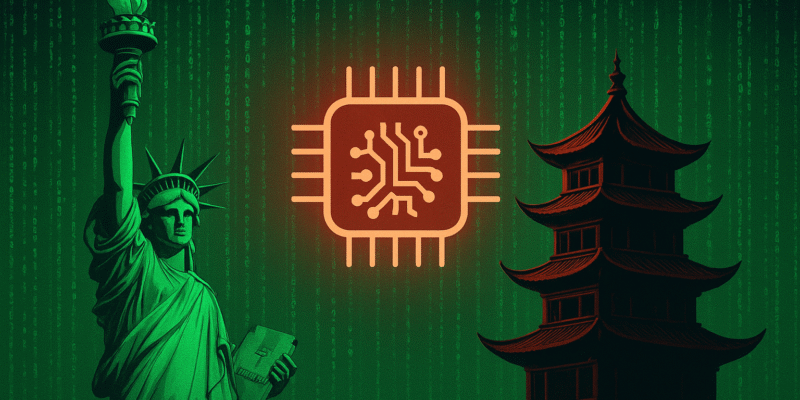
Right now, the United States and China are fighting a quiet, relentless battle for control over the most powerful weapon humanity has ever created: the semiconductor chip.
These fingernail-sized silicon wafers — the “brains” inside every phone, car, computer, and fighter jet — are the backbone of modern civilization. From your Wi-Fi router to the world’s largest data centers, semiconductors pulse through everything. But as the world’s dependence deepens, the line between innovation and infiltration has blurred.
When Chips Become the Battlefield
Taiwan, a small island sitting at the edge of the South China Sea, produces nearly 90% of the world’s advanced semiconductors, mainly through TSMC (Taiwan Semiconductor Manufacturing Company). Every artificial intelligence model, every U.S. military weapon system, every data-driven operation — all of them rely on this global lifeline.
Now imagine a world where that lifeline is cut.
If China invades Taiwan, the global semiconductor supply chain collapses overnight. Cars stop production. Smartphones are becoming scarce. Cloud systems begin to stall. And for the first time, cybersecurity professionals face an enemy not in code — but in silicon itself.
Because whoever controls the chips controls the future.
The Cybersecurity Implications of a Silicon Defeat
If China dominates semiconductor production, the world may face a new era of hardware-level cyber espionage. Unlike software hacks that can be patched or detected, vulnerabilities implanted in the chip design itself are nearly impossible to trace. Imagine billions of devices — routers, servers, cameras — silently transmitting data to adversarial intelligence networks.
Your phone might not just connect to the cloud — it might confess to it.
In an age where data is power, compromised microchips would turn every home, every office, and every government agency into potential spy nodes. This is not a dystopian future — it’s a strategic blueprint already in motion.
What Happens If the U.S. Wins
If the United States secures chip independence — through domestic manufacturing, AI-driven verification, and quantum-secure design — it could usher in a renaissance of digital sovereignty. Trusted supply chains, secure infrastructure, and energy-efficient chips would fuel the next wave of global innovation.
But it comes at a price. The world’s balance of power would shift. Nations dependent on American chips would be forced to align politically, deepening digital divides. The world would become a network of trusted and untrusted systems — a new kind of cyber cold war.
What Happens If China Wins
If China wins the semiconductor war, control over data, AI, and digital manufacturing will concentrate under authoritarian oversight. The global Internet would begin to “split” — a Western Internet and an Eastern Internet — each with its own infrastructure, surveillance rules, and power centers.
Cybersecurity as we know it would evolve into something darker — a surveillance-industrial complex where every byte is tracked, monetized, and weaponized. Even the smallest microchip in your smartwatch could become a state-sponsored Trojan horse.
The Future of Cyberspace Hangs by a Thread
The semiconductor war is more than a trade dispute. It’s a battle for control of consciousness — because in a hyperconnected world, whoever commands the chips commands the data, and whoever commands the data, commands the mind.
As global networks stretch further into the Internet of Things, 6G, and quantum computing, our very sense of autonomy depends on how this war ends.
So, when you charge your phone tonight or stream a movie, remember — every pixel, every packet, every moment of your digital life flows through a battlefield you cannot see.
And in that battlefield, the war for cyberspace is already being fought — one silicon atom at a time.
Closing Line:
The next great world power won’t be measured by its armies or its GDP.
It will be measured by who builds the chip — and who owns the backdoor.
Authored by Pinnacle Global’s Cybersecurity & Technology Writers